Trump orders agencies to write SI for AI
President Donald Trump signed the executive order Inaugurating the Era of Super Intelligence on 29 September 2026. The White House posted it at 21:17 UTC (05:17 SGT on 30 September).
Section 1 makes it executive branch policy to use "Super Intelligence" and "SI" in place of "Artificial Intelligence" and "AI". The branch "will not acknowledge the usage" of the old terms "in any applicable setting". Section 2 covers official correspondence, websites, reports and other non-statutory documents. The White House fact sheet says the old name implies "simply imitating or automating human intelligence".
Agencies change wording while the statute stays
The order binds executive departments and agencies "to the maximum extent permitted by law". Under Section 2(b), earlier regulations, contracts, grants and historical documents need no changes.
Section 3(a) defines SI by the existing statutory definition of artificial intelligence in 15 U.S.C. 9401(3). That holds until a later Presidential action or an Act of Congress replaces it. Section 3(b) gives the Assistant to the President for Science and Technology 60 days to propose legislative language for a federal SI definition.
A second order that day, Streamlining Access to Government Services Through America.gov, already uses the new term. Section 2(e) aims to "ensure that super intelligence used in connection with America.gov is accurate, reliable, and transparent". It covers online federal services with more than 100,000 users in a 12-month period, with exclusions such as IRS tax filing. OMB must issue an implementation memo within 90 days.
The America.gov fact sheet says passport renewal and Medicare enrollment will follow later this year. FedScoop reports that Joe Gebbia described 2027 plans for tracking processes on the site. It says Gebbia told CNBC that Google's Gemini and Musk's Grok power the platform. Neither order nor fact sheet names a model.
Accord text reaches readers only through press copies
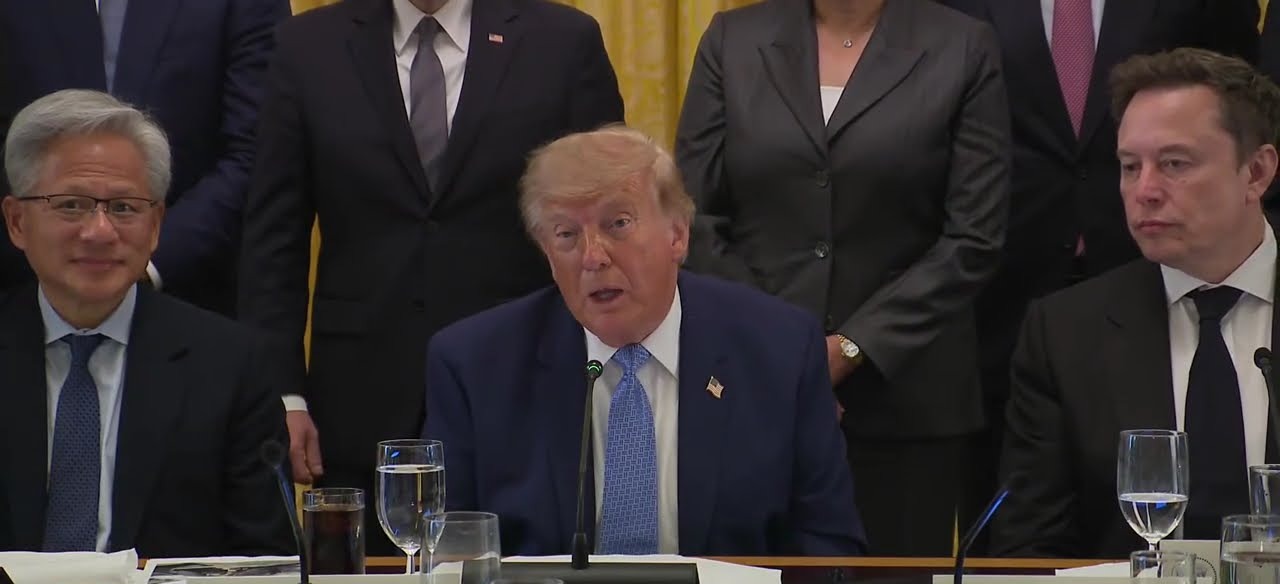
The Washington Examiner printed a full text of an accord titled "White House Accord on Super Intelligence Joint Commitment on Frontier Responsibilities". A second Examiner report says Trump told reporters he and tech leaders signed it after a White House meeting on 29 September. That report gives the title as "White House Accord on Superintelligence: A Joint Commitment on Frontier SI Responsibilities".
The Examiner names Sundar Pichai, Mark Zuckerberg, Dario Amodei, Elon Musk, Jensen Huang and Greg Brockman as signers. In its copy, each company "should implement" four layers of controls and audits:
- internal controls that monitor model capabilities and alignment during training and deployment in areas like cybersecurity, biosecurity and chemical threats;
- an internal team that checks the controls operate as intended and that issues are remediated;
- an independent external auditor or evaluator;
- an independent board committee that oversees and receives reports from those teams and auditors.
The companies "will meet regularly to establish standards and best practices", the copy says, and "it may make sense to codify these steps into laws or regulations" over time.
Panelists describe a joint declaration
At the America.gov launch, moderator Gavin Baker asked Musk, Huang and Anthropic co-founder Tom Brown about the lunch. One panelist said they "signed a joint declaration" on SI safety, adding, "I think that'll be published by the White House soon if it hasn't been already." The speaker listed "joint monitoring", "board special committees" and "grading each other's homework which is a lot better than if people just grade their own homework". FedScoop attributes that line to Musk and renders it as "joint-monitoring, boards, special committees".
The DRM News clip's transcript then marks a new, unidentified speaker. That speaker listed "rigorous internal controls", internal audit that escalates, third-party external audits and "industry sharing best practices". The speaker said they thought the declaration has "a lot of teeth".
Huang on containment, Musk on power
Huang said that "even though you have it contained, you should never trust that it's contained." He described OpenShell as a containment system and a BlueField chip that "just keeps an eye on everything that the agent is doing at all times". See NVIDIA launches Open Agent Safety Platform on 28 September with OpenShell runtime and BlueField-4 Sentry watchdog.
Musk said he "would bet anyone that 1% increase in power usage corresponds to roughly 1% increase in GDP". He said Starship will launch "at least a few hundred" gigawatts a year of AI compute. Both are his own estimates.
Vance points to the FTC and Justice Department
Vice President JD Vance later said existing laws make developers responsible when their products become tools for cyber warfare. He named "the two obvious agencies" as the FTC and the Department of Justice. He questioned "an FDA or an FAA for new frontier models", saying "most bureaucrats just know way less about this". He said giving Section 230 protections to some new technology companies would be "a huge mistake". He also said "the best weapon against cyber offense is good cyber defense."
Vance added: "We don't want the four or five biggest model companies ... to join in a sort of unified cartel against the American consumer." An antitrust suit makes a related claim: Buist v. Anthropic: the pace-the-frontier complaint as a Sherman Act filing.
No official accord text and no named auditor
These points remain open:
- No White House or signatory page carried the accord text when The Frontier checked at 12:02 SGT on 30 September.
- The Examiner reports Trump called the accord "morally binding" and Speaker Mike Johnson calling it "commitments that are voluntary on behalf of the industry".
- The Examiner copy names no auditor, deadline or public reporting duty.
- Quotes were checked against a transcript of the event, with names corrected. The White House streamed Announcement on America.gov and posted Vice President JD Vance Holds a Fireside Chat. The Frontier read the accord answer in a DRM News clip.
Dates to track through 28 December
- Expect "SI" in agency documents and websites.
- The SI definition proposal is due 28 November 2026, by our count.
- The OMB memo is due 28 December 2026, also our count.
- The Examiner reports that Trump said he would name an AI czar in "the next three or four days".