textGrain watermarks for EU ChatGPT and Codex text
OpenAI published Our approach to EU text provenance rules on 5 October 2026. It sets out a phased plan for text watermarking, which OpenAI ties to the EU AI Act.
OpenAI says the AI Act requires generative AI providers to make generated text identifiable in a machine-readable way. The plan has three parts:
- From 5 October, API customers globally can opt in to text watermarking for select models. Watermarking stays off by default in the API.
- Over the coming weeks, OpenAI will add an invisible watermark to eligible ChatGPT and Codex text output in the European Union.
- Approved researchers and expert organizations can apply for access to the text watermark detector.
EU users on all plans, API customers by choice
OpenAI says the EU rollout covers eligible ChatGPT and Codex users across all plans, in the EU only. It says text watermarking will not be a global default at launch.
API customers anywhere can choose watermarked output for select models. Neither the post nor OpenAI's help article lists those models. OpenAI says it is also working with cloud partners to offer watermarking for its models in the coming weeks.
The post says detector access will be granted case by case, in line with the Code of Practice. The European Commission's Code of Practice on Transparency of AI-generated Content supports the Article 50 marking and labelling duties. The Commission says those duties apply from 2 August 2026 and that signing the code is voluntary.
For how operators prepared for those duties, see EU AI Act transparency war room runs while high-risk clock moves to 2027.
A keyed signal in word choices
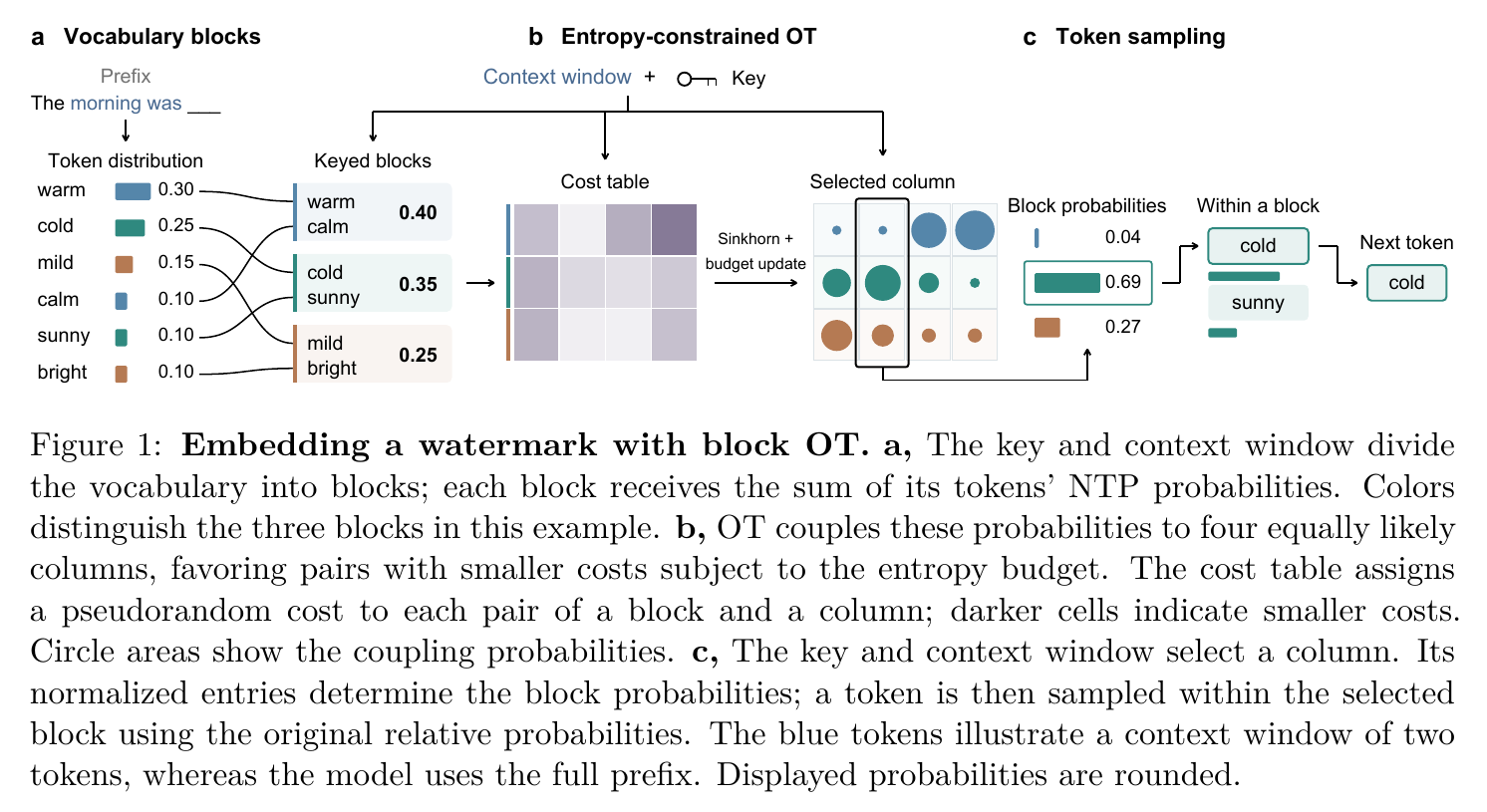
OpenAI says textGrain adds an invisible statistical signal to the model's word choices. Its detector looks for that signal in a passage.
The 20-page textGrain technical report, dated 5 October 2026, gives the method. Generation ties token choices to keyed randomness under a set budget for lost sampling entropy. The report says the detector needs only the text and the secret key.
OpenAI says textGrain matched or exceeded the other approaches it tested, including SynthID for text. It adds that strong results under ideal conditions do not guarantee reliable detection in everyday use. It also says it saw no meaningful benchmark differences for its Astra model with and without watermarking. OpenAI plans to release the technology as open source.
OpenAI says its image and audio verification tools stay publicly accessible. Its help article on provenance signals lists C2PA metadata and SynthID for images and SynthID for audio.
Short passages and synonym swaps weaken detection
OpenAI's own evaluations show the limits:
- At a target false positive rate of 1%, the detector found watermarks in about 80% of 200-token passages. It found about 95% of 400-token passages, for content such as psychology.
- Detection was substantially lower for content such as mathematics, where word choice is less flexible.
- In 400-token passages, replacing 10% of words with synonyms cut detection from about 92% to 66%. Replacing 25% cut it to 17%.
The Frontier found no independent test of textGrain. OpenAI says the technical report will gain more detail in the coming weeks.
OpenAI lists what a detection result cannot show:
- A watermark does not measure human contribution.
- It does not establish ownership or responsibility.
- It does not identify the user, account, prompt or conversation.
- It does not verify accuracy.
OpenAI also says a missing watermark does not prove human authorship. The text may be too short, edited or translated, or it may come from an unsupported model or another company's tools.
API teams decide opt-in, EU readers should expect marks
- API teams with EU transparency duties can decide model by model whether to opt in, and ask OpenAI which models qualify.
- EU organizations that publish ChatGPT or Codex text should expect an invisible watermark in the coming weeks.
- Editors and teachers should not treat a missing watermark as proof that a person wrote a passage.
- Researchers who study provenance can apply for detector access now.
The Commission is also consulting on copyright and AI. See EU targeted copyright consultation weighs an AI opt-out registry, crawler disclosure and a remuneration right, open until 3 November.