
Brussels asks how AI should pay for content
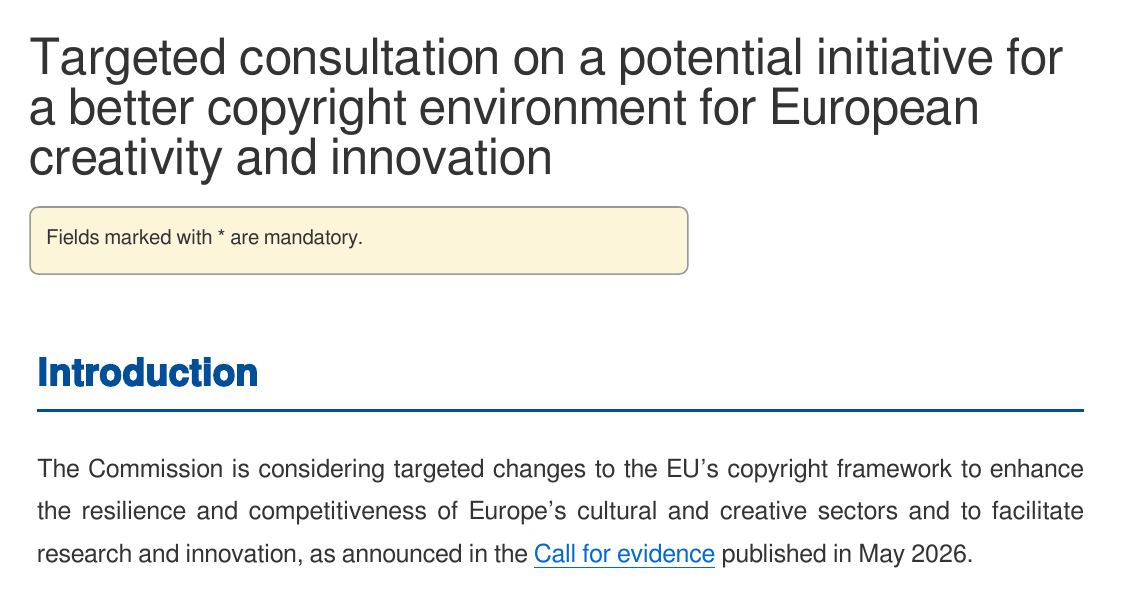
The European Commission is running a targeted consultation on changes to EU copyright law. Its news page, last updated 1 October 2026, says it stays open until 3 November 2026.
The full questionnaire runs to 36 pages. It has four policy sections:
- copyright and generative AI
- online piracy of live events and other time-sensitive content
- use in the EU of sound recordings by nationals of non-EU countries
- copyright and research
The questionnaire says it builds on a call for evidence from May 2026. Its outcome will feed a "targeted initiative for a better copyright environment for European creativity and innovation."
Rightholders, AI providers and crawlers in scope
The Commission invites copyright holders, generative AI providers, collective management organisations, intermediaries and research bodies. National authorities, consumer groups and NGOs are also on the list.
Answers go through the EUSurvey form. Respondents can skip sections and upload supporting documents, marked confidential if needed.
The AI section recaps the current rules. The DSM Directive's Article 4 exception allows text and data mining unless rightholders reserve their rights under Article 4(3).
The AI Act adds a copyright policy and a public training data summary for general purpose AI models, under Article 53(1)(c) and (d). The questionnaire says the Commission can fine providers up to 3% of worldwide annual turnover for breaches.
Eight enforcement ideas and seven licensing tools
Question 6 asks respondents to rank enforcement mechanisms. The options include:
- a common opt-out vocabulary, EU standards for opt-out protocols and an EU registry for opt-outs
- clearer rules on how EU copyright applies to AI uses, including territorial reach
- an obligation on web crawlers and AI agents to disclose identity and purpose
- record keeping on licensing and opt-out checks for a defined period
- independent audit or certification of how protected content is used
- disclosure under NDA on a substantiated request from collecting societies or rightholders
- court or authority disclosure orders in legal proceedings or mediation
- a rebuttable presumption of use where providers miss AI Act transparency duties
The NDA option is framed as an alternative to publishing the top 10% of domain names crawled. The AI Act training summary template currently requires that disclosure, the questionnaire says.
Question 8 covers licensing. It asks separately about training, inference time use and outputs. The options include:
- a licensing marketplace with automated licensing at scale
- model contract clauses for AI licences
- a duty to negotiate in good faith
- structured mediation or arbitration by an independent body
- extended collective licensing
- fair compensation for unreserved uses under the Article 4 exception
- a remuneration right for certain uses by generative AI providers
A consultation with no position yet
The questionnaire carries a disclaimer on its options. Including them "should not be understood as indicating that the European Commission has taken a position in favour of a particular option."
It adds that the list is not "an exhaustive or final set of measures under consideration." It says the options come from public debate, member state talks and the European Parliament report 2025/2058(INI).
Question 5 asks for the overall approach. The choices run from keeping the status quo to soft law, non-legislative measures or new binding copyright rules.
A separate section covers AI imitations of performers. It says copyright law does not protect specifically against AI imitations of a performer's likeness.
The questionnaire says the GDPR and AI Act deepfake labelling may apply. It asks whether specific EU rules are needed for performers' likeness.
AI developers and publishers have until 3 November
- General purpose AI providers in the EU market should map their opt-out handling and crawler identification against the question 6 options.
- Publishers and collecting societies weighing licensing deals can rank the question 8 tools for training, inference and outputs separately.
- Open model developers publishing AI Act summaries now can show what is workable. Aleph Alpha's new release is one example. See Aleph Alpha Kolibri-1 opens 78B German and English MoE weights under Apache 2.0, with 3.46B active parameters.
The US debate over training and fair use runs through the courts. See DOJ tells S.D.N.Y. OpenAI MDL that LLM training on copyrighted text is fair use.