
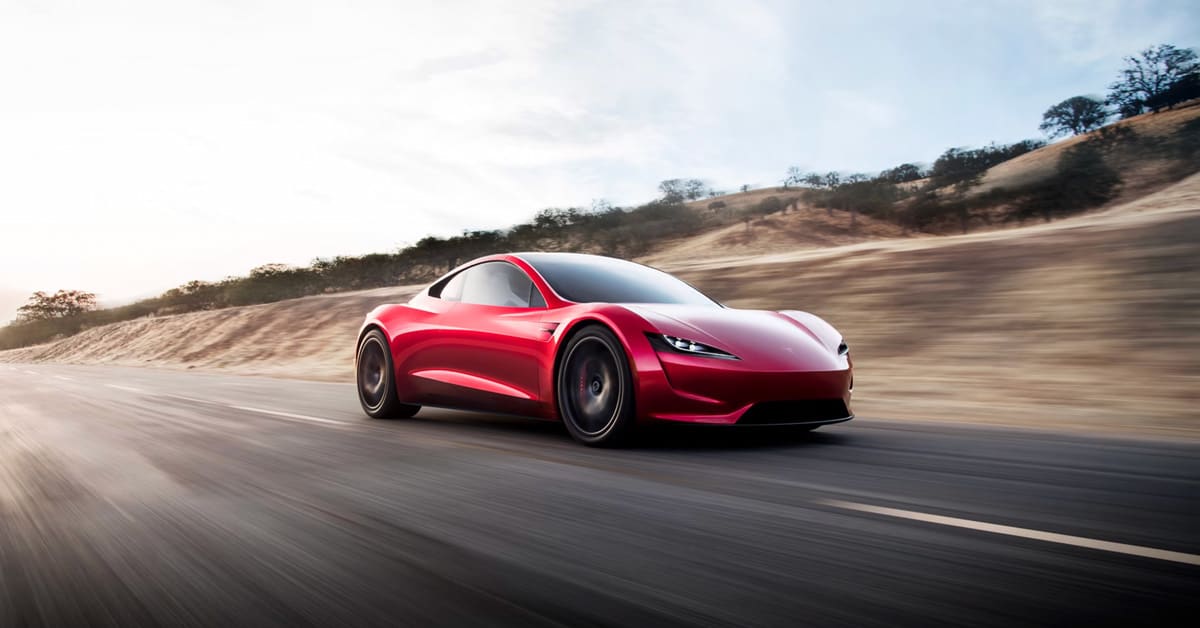
For years the flying car sat between science fiction and engineering ambition. On 15 October 2026, at SpaceX's test site in McGregor, Texas, Tesla gave that idea a concrete few seconds.
The redesigned second-generation Roadster drove up a curved ramp until fan suction held it nearly upside down, left the structure, spun on cold-gas thrusters, and landed. It then jumped a line of parked Teslas, including a Semi, in what engineering vice-president Lars Moravy called a kickflip. The night was a stunt show as much as a product launch: a glimpse of what happens when an automaker decides the road need not be the whole story.
Those manoeuvres were brief, planned, and run under controlled conditions. Sustained flight in ordinary use is a larger problem, and Tesla still has to turn the spectacle into a car people can buy and run. The demo is still worth taking seriously for what the hardware actually did.
Cold gas and fan suction did the work on stage
The livestream came from McGregor, near Waco, with Elon Musk, Franz von Holzhausen and Moravy on the mic. Musk wanted a live crowd "to prove that it's not AI," and he admitted success was uncertain. For the stunts themselves, software drove: Musk called the demo "technically autonomous," and Engadget's liveblog noted an Optimus or Starman prop in the seat while the routines ran programmed.
Two systems shared the physics. Under the car, a multi-mode fan and ground-sealing setup pulled air out so ambient pressure could pin the Roadster to the ramp, even when stationary. Musk put that suction at up to about two g. The inverted cling was downforce from a sealed floor.
Around the car, cold-gas nozzles fed by carbon-fiber overwrapped pressure vessels did the aerial work. Those COPVs are the same family of tanks SpaceX already flies on rockets. Moravy said ten thrusters share about 600 litres of compressed air, roughly 250 kilograms across two tanks. Tesla claims more than 80 kilonewtons of thrust. Interior photos show a thruster pressure readout near 5,500 psi, and the plumes carry the shock diamonds of gas leaving faster than sound. Nothing burns. Musk said the air tank can recharge without special chemical propellant, so the car can "puff itself up" and try again. How long a refill takes, how much pack energy it costs, and how many seconds of full thrust a fill buys are details Tesla has left for later.
On the pad, Tesla's timer showed 0 to 60 mph in 0.81 seconds after a recorded one-second run. That is the company's own clock on a thruster-assisted sprint. Musk expects production cars to go faster still, with the real limit framed as what a human body can take.
Three trims turn the same kit into road, race and air packages
After the stream, Tesla's site and its X thread sorted the hardware into three configurations.
Performance is "road ready": two seats, active aero, and the multi-mode suction system, with Tesla quoting 0 to 60 under 1.6 seconds and more than 300 miles of range. Thrust is limited release, adding rear cold-gas thrusters and quoting under 0.9 seconds to 60. Rocket is "air ready" and invite only: one seat, thrusters around the perimeter for forward, upward and rotational movement. Tesla writes "So yes, it can fly," and notes the trim is not approved for public road use. Company figures for Rocket include under 0.59 seconds to 60 and a top speed over 230 mph. Musk separately teased half the speed of sound; the 230 mph-plus line is the one Tesla is stating in trim copy.
Reservations follow the old deposit shape: $5,000 due today, fully refundable, then $45,000 within ten days for Performance, matching the familiar $50,000 total. Thrust sits near $250,000 in deposit language across outlets. Rocket stays invite only. No purchase price landed on Thursday. A 2017-era base near $200,000 is still the last public number of that kind.
The flight demos match the Rocket capability story. The mule on stage still looked like a two-seater with a prop in the chair, while production Rocket copy lists a single seat, so seating and tank packaging may still move before customers see metal.
An eight-year SpaceX pitch finally left the tweet
Musk floated thrusters on 9 June 2018: roughly ten small rocket thrusters around the car to improve acceleration, braking and cornering, and "maybe" to let a Tesla fly. That same weekend he was already talking about cold gas, COPVs and an electric pump to refill compressed air. Thursday's language makes that pitch tangible for atmospheric use, with Tesla saying every usable void is packed with pressure vessels so more gas means more "flight time."
The car around the thrusters has its own long fuse. Tesla surprised the second-generation Roadster into view in November 2017, took large deposits, and talked about deliveries around 2020 with four seats, about 620 miles of range and a 1.9-second 0 to 60. Range and seating have since drifted toward roughly 300 miles and two seats at most, while acceleration claims climbed once thrusters entered the story. The reveal itself slipped through 2025, April Fool's jokes, an October 1 weather delay, and finally 15 October 2026.
Musk has long cast the Roadster as unlikely to move Tesla's financial needle in a major way, the "small potato situation" Reuters restated around the reveal. Morningstar's Seth Goldstein sees the missing halo car, with volume on the order of a couple of thousand units a year against roughly 1.6 million vehicles Tesla sold last year. Musk called it the last best driver's car while Tesla pushes robotaxis, Cybercab and Optimus. Electrek's read after the X thread was that the stunts live on limited or invite trims rather than the volume story.
The hard work starts after the kickflip
Getting airborne for a few seconds is the vivid part. Making thrust predictable and useful beside ordinary traffic is the longer one. A car that can fire tens of kilonewtons of cold gas brings crash loads, plume risk and multi-g landings into a world built for tires and crumple zones. On stage Musk said the machine is "not necessarily a safety-optimised" car. Earlier this year he told a podcast audience that if safety is the top goal, they should skip the Roadster.
Regulators will have to catch up if any of this leaves the pad. Reuters found the legality of thruster features on public roads unclear after the event. Tesla's Rocket note already says the trim is not approved for public road use. Musk allowed that rules may vary by jurisdiction while insisting someone will be able to own such a car. Neither NHTSA nor FAA has published a routine path for thruster hops in mixed traffic, and Tesla has not laid one out in public.
Energy and endurance sit in the same unfinished folder. Compressed air can deliver a short, fierce push; how often the tanks refill, and how much "flight time" a full charge really buys, will decide whether the thrusters are a party trick or a repeatable tool. Until Tesla publishes those budgets, and until independent labs put timers and thrust stands on the car, figures such as 0.81 seconds and "over 80 kN" remain the company's.
A crossover worth watching past the fireworks
Tesla has put SpaceX-grade pressure vessels, cold-gas attitude control and fan suction into a sports car and made the combination do something tire-limited EVs cannot. That crossover is the real signal from McGregor: aerospace technique, briefly, in a consumer shape.
Treat the McGregor timer and thrust figures as Tesla's until an independent lab repeats them. Watch Rocket and Thrust for closed-course demos; treat road legality as unfinished. Production is cited for 2028. The open question is whether customers get a car they can buy, certify and run without a SpaceX pad and a programmed routine.