
85.7% of workers, 23.5% of firms
Most surveyed workers in Singapore now use AI at work, while most Singapore firms have yet to adopt it. In 2026, 85.7% of surveyed workers reported using AI tools at work, up from 77.6% in 2025. AI adoption among all enterprises reached 23.5% in 2025, up from 14.7%.
Both figures appear in the Infocomm Media Development Authority's Singapore Digital Economy Report 2026, which IMDA announced in a press release on 5 October 2026. The two numbers come from different sources, one covering workers and one covering enterprises.
IMDA puts the digital economy at S$144.1 billion in 2025, or 19.3% of GDP. The 2024 figure was revised to S$136.5 billion, or 18.8%, after the Department of Statistics refined the national accounts.
IMDA counts firms, MDDI asks workers
IMDA's own data cover enterprise adoption, split into SMEs and larger local firms. SME adoption rose from 14.5% to 23.4%, and adoption among large local enterprises rose from 62.5% to 70.4%. Large local firms adopt at three times the SME rate. The worker charts cite the Ministry of Digital Development and Information (MDDI) as their source.
Neither the press release nor the 31-page report gives the worker survey's sample size or fieldwork dates. The press release rounds the worker figures to 86% and 78%.
AI-adopting firms gave their own estimate of staff skills. They said that, on average, 71.9% of their workers could use AI in some capacity in 2025. They placed 47.6% at general tasks only, 19.3% at intermediate tasks and 5.0% at developing or deploying AI for complex tasks.
IMDA chief executive Ng Cher Pong said in the release that IMDA "remains committed to investing in continuous learning".
Small firms still see no need
The report's barrier table lists the reasons firms give for holding back. Among firms without AI, 54.7% said in 2025 that they do not see the need because they are a small business, against 57.4% in 2023. Cost, IT readiness and skills barriers all fell over the same period. The share of non-adopters planning to adopt within a year rose from 5.6% in 2023 to 12.1% in 2025.
Firms that do use AI mostly buy it ready-made. Of AI-adopting firms, 89.6% use off-the-shelf tools, 28.3% customise commercial tools and 23.0% use tools built in-house or outsourced. About 2 in 5 are expanding deployment or have fully deployed AI. Only 6.6% report full deployment.
Among firms with 10 or more employees, Singapore's rate rose 13.2 points to 34.6%, against an OECD average of 20.3%.
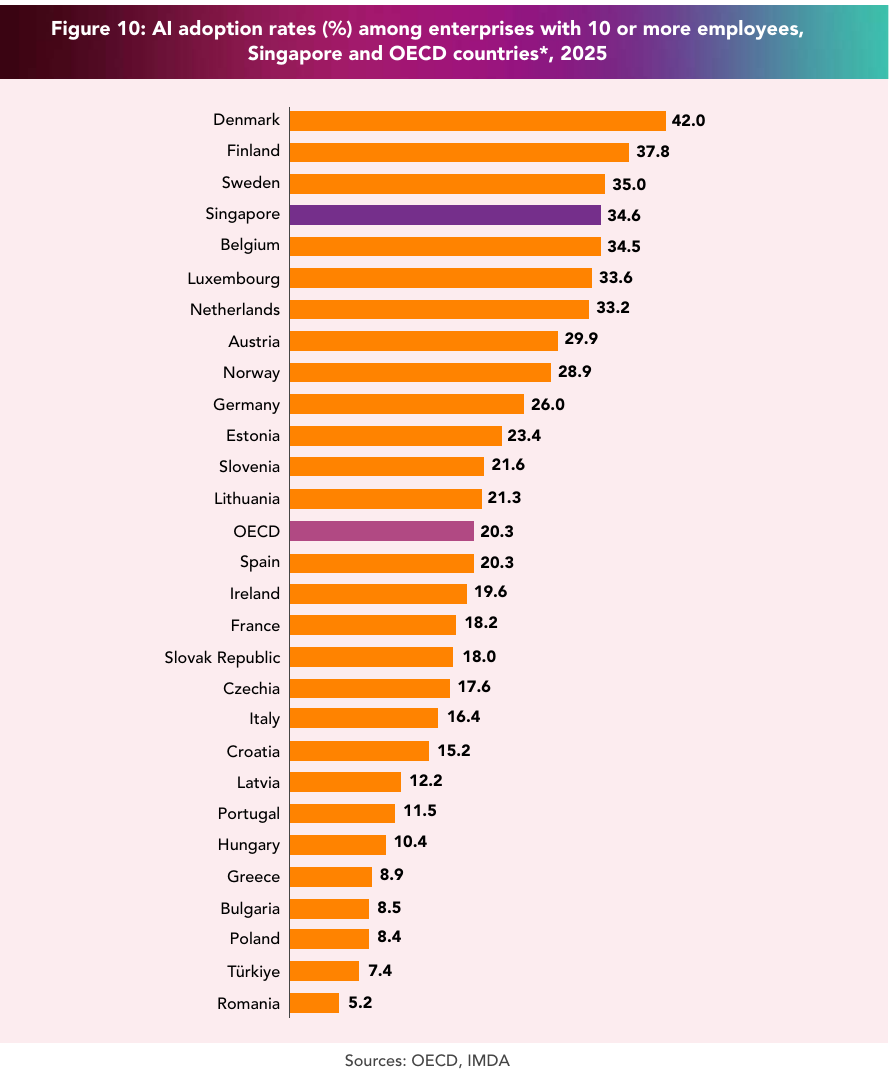 Singapore ranks behind Denmark, Finland and Sweden among the economies with 2025 data.
Source: IMDA, Singapore Digital Economy Report 2026, Figure 10
Singapore ranks fourth of the 28 economies in that chart, 0.1 points ahead of Belgium. The chart excludes countries without recent data, such as the US, UK and Israel, from both the ranking and the OECD average.
Training trails the need by 31 points
More than two thirds of surveyed workers agreed they need AI training. Only 36.7% had attended AI-related training in the past 12 months. That leaves a gap of about 31 percentage points between need and uptake.
Workers who skipped training gave these main reasons:
- 34.9% were not sent for training by their employer.
- 34.1% lacked time.
- 26.6% did not know how to choose the right course.
IMDA's TechSkills Accelerator will upskill 40,000 tech professionals over three years. The National AI Impact Programme will train 100,000 professionals in domain AI skills by 2029. Its rollout is already under way in sectors such as accountancy and law. In accountancy, a Mercor study published on 1 October scored 12 licensed accountants on simplified tasks that Mercor says models now ace. See Mercor CPA study: 12 licensed accountants averaged about 37% on simplified APEX-Accounting tasks that models now ace.
Some benefit figures are self-reported. The 49.5% average cost saving for SMEs using AI solutions under the Productivity Solutions Grant rests on applicants' own declarations, the release says.
Employer nomination tops the training barriers
- Employers in Singapore can act on the top training barrier directly, since it is their own nomination.
- Vendors and grant programmes aimed at SMEs face a market where 54.7% of non-adopters see no need for AI.
- Sellers of AI tools face buyers who mostly want ready-made products, since nearly 9 in 10 adopting firms use off-the-shelf tools.
- Teams choosing where to run models in Singapore have local options. AWS added in-region Claude inference in Singapore on 30 September. See Amazon Bedrock adds in-region Claude inference in Seoul and Singapore and an India-only cross-Region profile.