
Qwen-Image-2.1 ships under a research licence
Alibaba's Qwen team released Qwen-Image-2.1 on 20 September 2026. The weights sit on Hugging Face and ModelScope, with code on GitHub.
The licence file is the "Qwen RESEARCH LICENSE AGREEMENT", dated 20 September 2026. It grants rights to use, copy, modify and redistribute the model "FOR NON-COMMERCIAL PURPOSES ONLY". The licence defines non-commercial use as "research or evaluation purposes only".
Commercial users need a separate licence. The agreement directs them to model-business@notice.qwencloud.com.
The first Qwen-Image model used Apache 2.0, according to its GitHub licence file and Hugging Face card. The Qwen-Image-Edit models and Qwen-Image-2512 on Hugging Face also list Apache 2.0. Version 2.1 is the first model in this line on the Hugging Face listings to carry a non-commercial licence.
Tongyi Lab licenses the model from Hangzhou
The licensor is Hangzhou Tongyi Laboratory Technology Co., Ltd. Chinese law governs the agreement. The People's Courts in Hangzhou have exclusive jurisdiction over disputes.
The Qwen team publishes the model under its QwenLM GitHub organisation and its Qwen Hugging Face account. The Hugging Face card lists the licence as "other", with the name "qwen-research".
The two prompt-rewriting models, Qwen-Image-2.1-PE-T2I and Qwen-Image-2.1-PE-I2I, also list the "other" licence on Hugging Face.
A 7B generator with RGBA output and 10 references
The README describes a unified model for text-to-image generation and image editing. Its visual generation component has 7B parameters in 32 single-stream DiT layers.
Other stated features:
- A Qwen3-VL 8B text encoder that encodes text instructions and condition images.
- A 64-channel RGBA autoencoder, so the model can generate transparent images and edit transparent layers.
- Native 2K output, with 2048 by 2048 pixels as the default size.
- Editing with up to 10 reference images, plus local edits marked by circles, painted notes or masks.
- A prefix key-value cache that encodes the text and condition images once and reuses them across denoising steps.
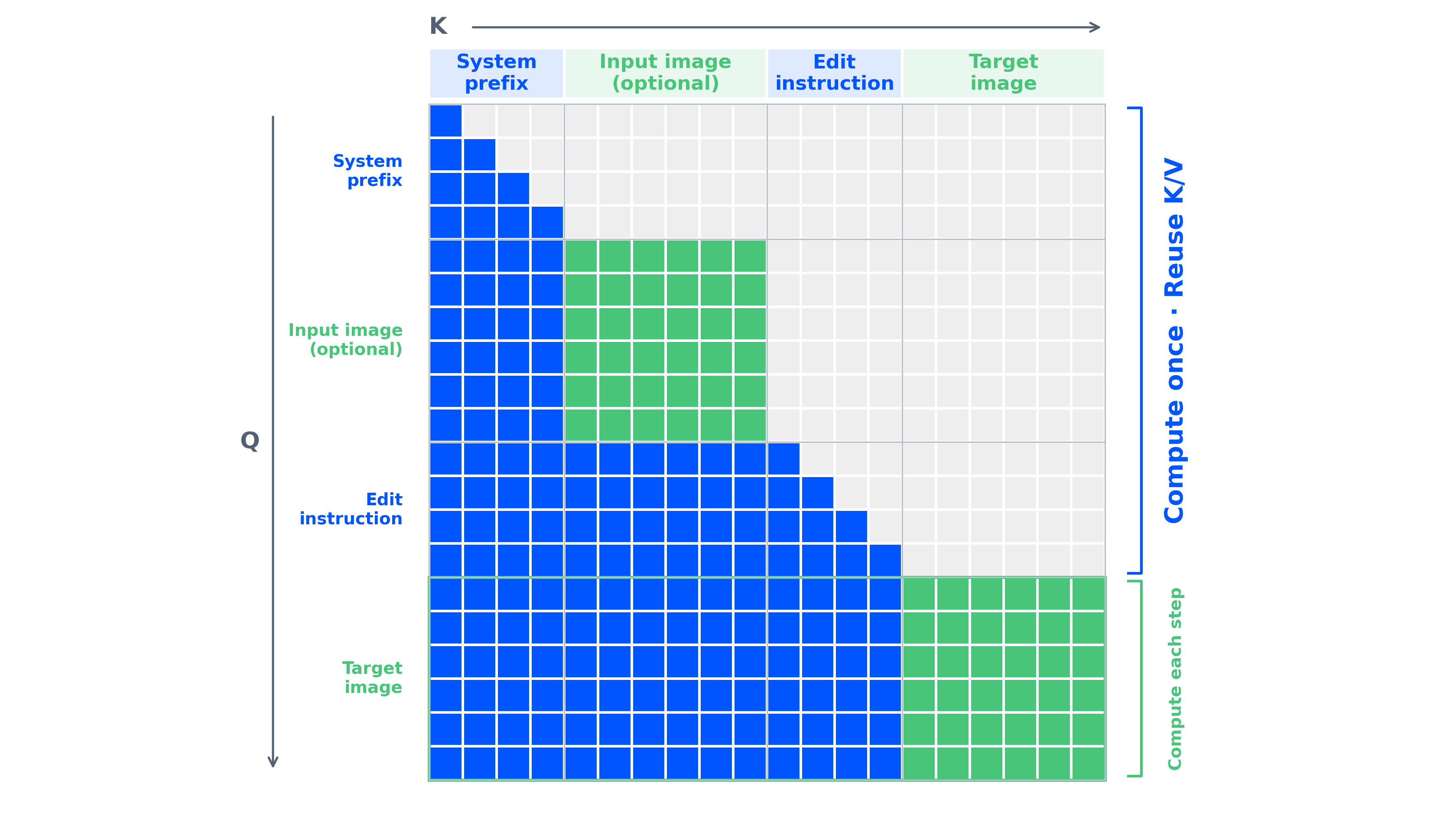 Caption: Block-causal attention mask with prefix key-value cache reuse, from the README's Architecture section · Source: Qwen team, Qwen-Image-2.1 README · link
The release had same-day support in Diffusers, ComfyUI, vLLM-Omni, SGLang and LightX2V. The optional prompt rewriters are two fine-tuned Qwen3.5-VL 9B checkpoints.
Attribution, naming and litigation terms bind users
The research licence adds duties that Apache 2.0 lacked:
- Anyone who distributes a model built or improved with Qwen-Image-2.1 outputs must display "Built with Qwen" or "Improved using Qwen".
- Derivative products may use "Qwen" descriptively. They cannot use it as the primary name.
- Redistributors must ship a Notice file with the licence's attribution text.
- All licences end on the date a user sues Tongyi Lab or any entity over IP in the materials or their outputs.
- Tongyi Lab may terminate the agreement for any breach. Users must then delete the materials.
The licence gives no numeric threshold for commercial use, such as a user count or revenue cap. Any commercial use needs a separate agreement.
The Qwen team gives no public reason for the licence choice. The README and model card state the licence without comment.
Product teams should re-check their image stacks
- Teams that run Qwen-Image or Qwen-Image-Edit in products should pin those Apache 2.0 checkpoints. Upgrading to 2.1 changes the licence terms.
- Commercial teams that want 2.1 should contact model-business@notice.qwencloud.com before deployment.
- Researchers can use and fine-tune the model at no cost for research or evaluation. Published derivatives need the "Built with Qwen" notice.
- Platform operators that host community fine-tunes should flag 2.1 derivatives as non-commercial.
- ComfyUI and Diffusers users should check the licence of each downloaded checkpoint. The same tools load both Apache and research-licensed weights.