
722 manuscripts, one unnamed model
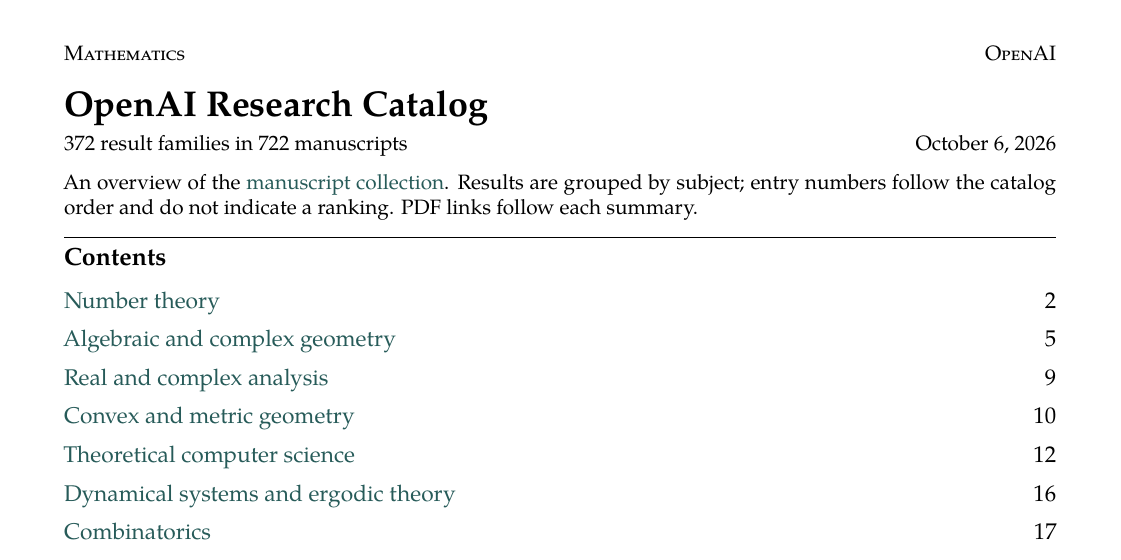
OpenAI has published 722 mathematics manuscripts from a model it has not named or released. Its own formal proof catalogue lists only 162 of them.
The company announced the release in a post dated 6 October 2026, with the papers in a GitHub repository under its own account. The repository README groups the manuscripts into 372 result families and says they come from "an unreleased internal OpenAI model".
OpenAI says it drew on advice from the Advisory Group on Mathematics and Artificial Intelligence (AGMAI). OpenAI places the independent group at the Institute for Advanced Study. On the same day, AGMAI said its advisory role "should not be interpreted as a judgment of the impact of these results or an endorsement of the process".
What OpenAI says the model produced
The README says the model was posed about 4,000 problems during the evaluation. OpenAI kept results that met "an appropriate level of significance" and grouped them into the 372 families.
Each result used three hours of ChatGPT Pro thinking compute on average, according to the README. It names two exceptions to that fixed procedure. One is work on a zero-free region for the Riemann zeta function, and the other a proof of the Hodge Conjecture for CM abelian varieties. OpenAI says one Riemann zeta writeup was human edited for readability.
OpenAI's overview makes large claims for its first entries. It says entry 003 proves every Dirichlet L-function is zero-free for real part above 7/8. It says entry 004 resolves Hilbert's tenth problem over the rationals negatively. The Lean catalogue lists the 7/8 paper but not the Hilbert's tenth paper. These are OpenAI's descriptions, and the README warns: "Some of the unformalized results could have issues."
How the release compares with AGMAI's rules
AGMAI published release guidelines for AI labs on 29 September, drawing on over 600 survey responses. Its survey asked about a case in which OpenAI announced many results without giving details. The Frontier checked the repository against five of those asks between 02:55 and 03:05 SGT on 8 October.
| AGMAI asks labs to | What the OpenAI release shows |
|---|---|
| Deposit results in a repository no AI lab controls | Papers sit in the openai GitHub account, and OpenAI says it is exploring community-hosted alternatives |
| Name the model behind each result | The README describes an unreleased internal model with no name |
| Publish prompts and a summarised chain of thought for each result | The README lists reasoning summaries for 10 of the 372 families, and the README, manuscript map and overview do not mention prompts |
| Give the time and estimated compute cost per result | The README gives an average of three hours of ChatGPT Pro thinking compute |
| Formalize proofs, with a formalization.yaml and comparator challenge files | The formalization catalogue lists 162 of the manuscripts and 185 formalized main results, each with a comparator configuration |
The 162 formalized papers are about 22% of the 722 manuscripts. The catalogue itself describes its scope as "Partial progress" and gives its review status as "unchecked".
AGMAI also asks labs to say how many comparable problems their models tried and failed, and how problems were chosen. The README gives about 4,000 problems posed, with no failure count and no list of the problems tried.
Human checking has barely started
The README says corrections will be recorded as new versions. Each manuscript directory carries a BibTeX block, and the one The Frontier checked points at OpenAI's GitHub copy. AGMAI asks for a persistent identifier from a repository no AI lab controls.
AGMAI said on 6 October that "it is ultimately up to the mathematical community to assess the extent to which our recommendations were followed successfully". It also said the release "is the beginning, not the completion" of human understanding.
OpenAI's post says it will work on "the citations, mathematical exposition, and presentation of the results" in future releases.
OpenAI already publishes principles for outside reviews of its models. See OpenAI publishes four priorities and seven principles for third-party safety assessments.
OpenAI said in September that it was still developing criteria for disclosing misalignment that is not a security incident. See OpenAI's misalignment ledger documents training incidents while its disclosure code is unfinished.
What mathematicians and labs can do next
- Mathematicians can test a claim directly. The formalization catalogue names the Lean declaration and comparator configuration for each formalized main result.
- The other 560 manuscripts do not appear in the catalogue.
- Citing authors can use the per-manuscript BibTeX, which links to OpenAI's GitHub copy, and record the version they read.
- AGMAI says equitable access to research tools matters. OpenAI says it is "working to responsibly release the model", with no date.
- OpenAI says it will fund workshops, conferences and special programmes and will "share more on this in the near future". AGMAI wants existing nonprofit institutions to decide which efforts get such support.