
OpenAI DevDay 2026 puts 25 launches in one recap
OpenAI held DevDay 2026 in San Francisco on 29 September US time, early 30 September in Singapore. Its DevDay 2026 Recap says the event brought "more than 20 major announcements". The Frontier counts 25 entries. Two have their own articles:
- OpenAI releases GPT-6.1 Sol covers the model priced at $2 input, $0.10 cached input and $10 output per million tokens. OpenAI's Sol post says it runs in ChatGPT Work, Codex and the API, and is not yet in Chat.
- OpenAI launches dots covers the always-on agents powered by GPT-6 Astra. The dots post says they are rolling out to Pro and Business Premium users in eligible markets.
Altman pitches models, tools and distribution
Sam Altman hosted the 53-minute keynote. Holly Li demoed dots, Tejal Patwardhan presented research and Romain Huet ran Codex demos. Quotes were checked against a transcript of the official recording and CNBC's reporting.
Altman said Ultrafast runs at eight times the speed of Standard for six times the price. He added: "We think you are really going to love this and not want to go back," a line CNBC also quotes.
He said: "We now have an AI research intern." Patwardhan said that as of July, OpenAI's models had taken on over a third of day-long internal research tasks with no intervention required.
Altman said the Responses API grew 100 times in a year while keeping reliability above 99%. He said time to first token fell 45% and tool calls and workflows got more than 30% faster. He gave no method for these figures.
He said about 1.2 billion people use ChatGPT weekly, and pitched Sign in with ChatGPT, plugins and the Marketplace as ways to reach them. He closed: "AI should be about giving people more power over their own lives."
Ultrafast, Decisions API and 21 more launches
Models, speed and plans
- Ultrafast is a new top speed tier. The Ultrafast guide enables it for
gpt-6-astrawithservice_tierset toultrafast. It supports global processing and US data residency only. - The API pricing page lists Astra Ultrafast at $60 input, $6 cached input and $300 output per million short-context tokens. Standard is $10 input and $50 output.
- In Codex and ChatGPT Work, Ultrafast needs Pro 500 or an eligible Enterprise or Edu plan. The Codex speed page says it uses included limits at eight times the Standard rate.
- The Decisions API focuses Luna on user-defined questions with fixed answers, for classifying content, routing requests or picking an agent's next step. The recap says it is in limited preview, with a broad release planned "in the coming days."
- Pro 500 costs $500 a month, says OpenAI's Pro tiers page, with 25 times the Plus allowance per the recap. Pro 200 reopens with a lower allowance.
Agents API, AWS and privacy
- The Agents API, covered in OpenAI opens the Agents API public beta, gains computer use. The changelog says agents use an OpenAI-hosted browser, "with website access approvals and sign-in handled by your application." The computer use guide has setup steps.
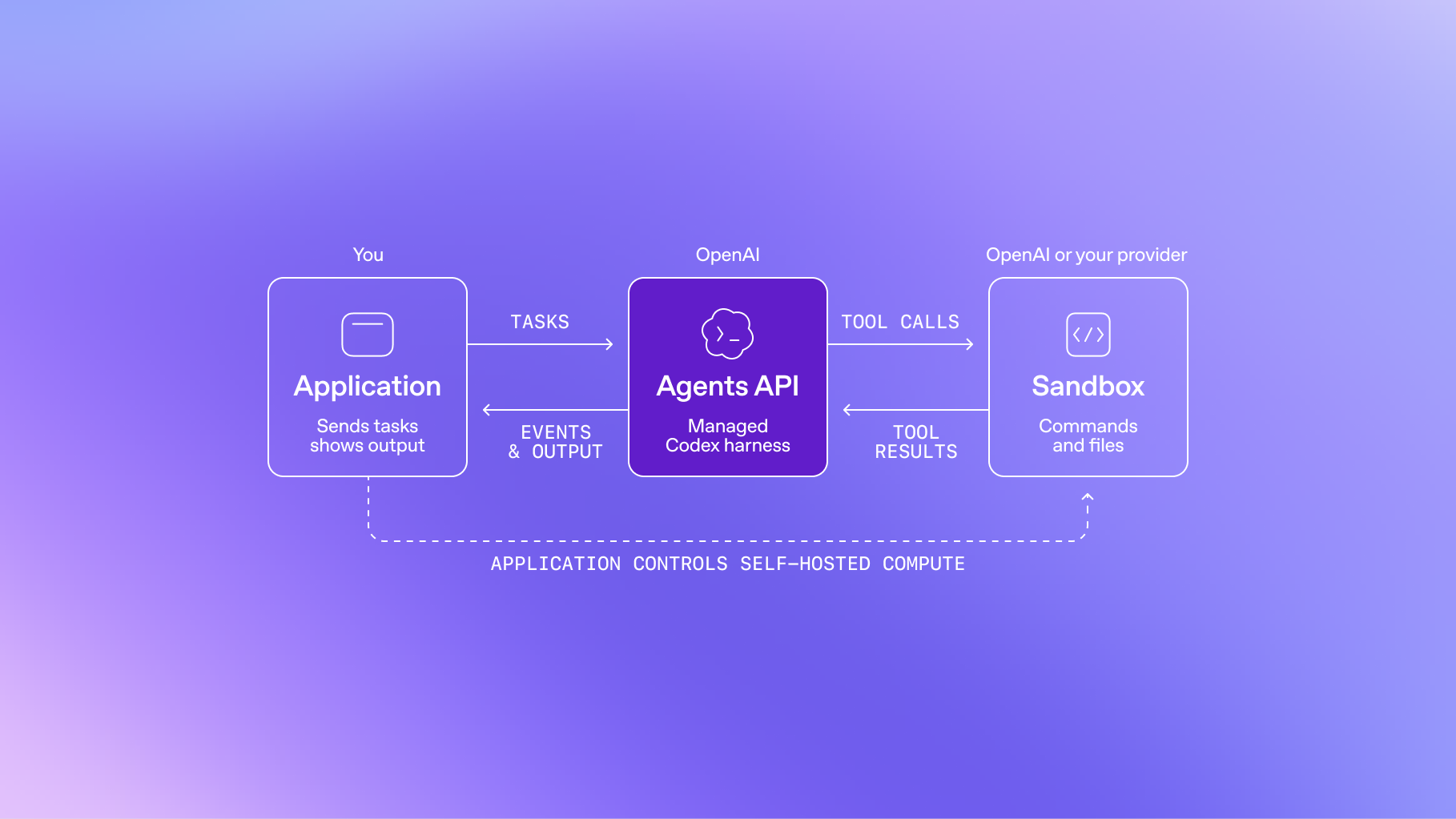 The Agents API sits between an application and its sandbox.
Source: OpenAI, DevDay 2026 Recap, 29 September 2026
- Amazon Bedrock Managed Agents, powered by OpenAI, is in preview. AWS says it runs OpenAI models and the Codex harness inside AWS under existing permissions.
- ZDR with Private Safety Processing keeps selected prompts and responses encrypted in the customer's own storage for 30 days. OpenAI's guide says a hardware-attested runtime with human access disabled reviews them. The recap says a Private Inference preview is "coming this fall."
Codex
- OpenAI says Codex Cloud tasks run in reusable environments and keep working while your computer sleeps. The recap lists Plus, Pro, Business, Healthcare, Education and Enterprise.
- The Codex CLI adds voice control, an agents view for parallel tasks and worktree support on all plans.
- Code Review in the desktop app shows diffs and runs automatic cloud reviews. GitLab support is in preview.
- Codex Security Cloud scans GitHub repositories on demand or on schedule and proposes fixes as draft pull requests. The recap lists Pro, Business, Enterprise and Edu.
Plugins and distribution
- Plugin extensions let a plugin add a sidebar app, a side panel and file viewers, with TypeScript and Python SDKs. A Plugin Creator and a redesigned submission flow also ship.
- MCP Events let plugins start automations when a connected app changes. ChatGPT needs MCP protocol version 2026-07-28 and supports webhook delivery only.
- Sites on Business, Enterprise, Healthcare and Edu plans can host plugins. Shareable profiles showcase Sites and plugins on Free, Go, Plus, Pro and Business plans.
- Sign in with ChatGPT lets Plus and Pro users spend their allowance in partner apps, with a weekly cap per app. The recap counts 16 partners.
- The OpenAI Marketplace lets eligible enterprises spend part of an OpenAI commitment on 32 partners' software, including Adobe, Figma and Salesforce.
ChatGPT for teams
- ChatGPT Space and Pages give people and agents shared documents on Pro, Business and Enterprise. Collaborative slides follow "in the coming weeks."
- Business and Enterprise get teams with scheduled tasks, and @ChatGPT in Slack and Microsoft Teams.
- The Meetings plugin is in macOS beta for Pro and Business. OpenAI says it deletes audio once notes are ready.
Missing prices, open dates and conflicting speeds
- OpenAI's speed figures differ. The recap says Ultrafast is up to 6x faster in the API and 8x in Codex. The API guide says "up to 8x faster speeds than Standard mode." The Codex page says its 8x covers token generation only.
- The recap gives no Decisions API price or latency. The Frontier found no Decisions API guide in OpenAI's API docs navigation at 12:05 SGT on 30 September.
- GPT-6.1 Sol Ultrafast has no date. At 12:08 SGT on 30 September the Codex speed page listed Sol with Standard and Fast only.
- OpenAI's Pro tiers page does not state the new Pro 200 allowance. The Decoder reports a cut from 20 to 10 times Plus usage in Work and Codex.
- Help pages say DevDay features are "gradually rolling out."
- The stage figures are self-reported. No independent test was available.
Price Ultrafast and test computer use first
- Price Ultrafast before switching. Keep it for latency-bound Astra paths and use WebSockets, as the guide recommends.
- Test
gpt-6.1-solon repeat-context agents against your own evals. - Try computer use in a sandbox project. Build website approval and sign-in handling first.
- Zero Data Retention customers should pick projects for Private Safety Processing carefully, since it covers all traffic in a project.
- Enterprise workspace owners must switch Ultrafast on for chosen users or the workspace. Eligible Pro 200 subscribers keep their old allowance until 29 October 2026.