
Free ChatGPT moves to GPT-6 Luna
Free ChatGPT users are getting a new Chat model that slips on several of OpenAI's own teen safety tests. OpenAI announced GPT-6 and Intelligent UI for everyone on 7 October US time (8 October in Singapore). Free and Go users get GPT-6 Luna in the Chat tab from 8 October US time.
Plus, Pro, Business and Enterprise users get GPT-6 Sol from launch day, and Enterprise access depends on workplace admin settings. OpenAI says both models "are tuned for everyday conversation". It says ChatGPT has more than 1.2 billion weekly users.
The October system card says these versions replace GPT-5.6 Sol and GPT-5.6 Luna in ChatGPT. Codex and ChatGPT Work keep the September versions. In September, Free and Go users got Luna on desktop only. See OpenAI launches GPT-6 Sol and Luna in API, Codex, and ChatGPT Work on 22 September.
Google is moving its free tier the other way. Google says personal Gemini accounts without an AI plan will be limited to Flash-Lite from 9 October. See Free Gemini users drop to Flash-Lite on 9 October, while Google's Singapore page still sells AI Plus with Pro.
Intelligent UI builds tools inside the answer
OpenAI calls the headline feature Intelligent UI. GPT-6 can compose answers from text, visuals, tappable buttons, forms, charts and interactive tools, the post says. Its examples include a savings calculator, a bill splitter, a road trip map and a game.
OpenAI says it built a library of native, streamable components and a compiler that renders the interface while the model is still generating. It says it trained the model on evaluations of the interfaces it made, for clarity, usefulness and completeness.
Users can tell ChatGPT to show fewer visuals, according to WIRED and TechCrunch. OpenAI product manager Aarush Selvan told WIRED: "We have a design team that spent a lot of time figuring out when adding a diagram, chart, or buttons adds value versus when it's starting to feel cluttered."
WIRED compares the feature with the generative UI that Google announced for Search earlier this year. OpenAI says there is "still work ahead to improve the model's design judgment".
Answers that start before thinking ends
GPT-6 in ChatGPT can start answering while it is still thinking, OpenAI says. It builds the answer over several partial responses.
- OpenAI says that in an internal evaluation of everyday agentic tasks, GPT-6 Extra High starts answering as quickly as GPT-5.6 Medium. It adds that GPT-6 Extra High scores better overall than GPT-5.6 Extra High.
- OpenAI says GPT-6 Instant starts answering 44% sooner on average than GPT-5.6 Instant for questions that need web search.
- OpenAI says GPT-6 addressed the key aspect of difficult questions more often than GPT-5.6 in another internal evaluation.
The post gives no scores, task counts or latency in seconds for these comparisons. All three are self-reported, and The Frontier found no independent test.
The system card shows teen safety slipping
The post links a 24-page PDF, GPT-6 Sol and GPT-6 Luna: October 2026 update, dated 7 October. OpenAI's Deployment Safety Hub carries the same card under 7 October.
The card says both October models show statistically significant regressions on OpenAI's under-18 tests. Against the August GPT-5.6 versions, both slip on age-restricted content, sexual content and emotional reliance. GPT-6 Luna also regresses on gore. By the card's own count, Luna regressed significantly on four of the six teen categories and Sol on three.
The largest drop is emotional reliance. GPT-6 Luna scores 0.734 against 0.927 for GPT-5.6 Luna, and GPT-6 Sol scores 0.770 against 0.921 for GPT-5.6 Sol. OpenAI says that test is "overly sensitive to the use of benign nicknames" such as "bro" or "bestie". It also says an extra classifier block for teens on self-harm, sexual content and gore is not counted in the scores.
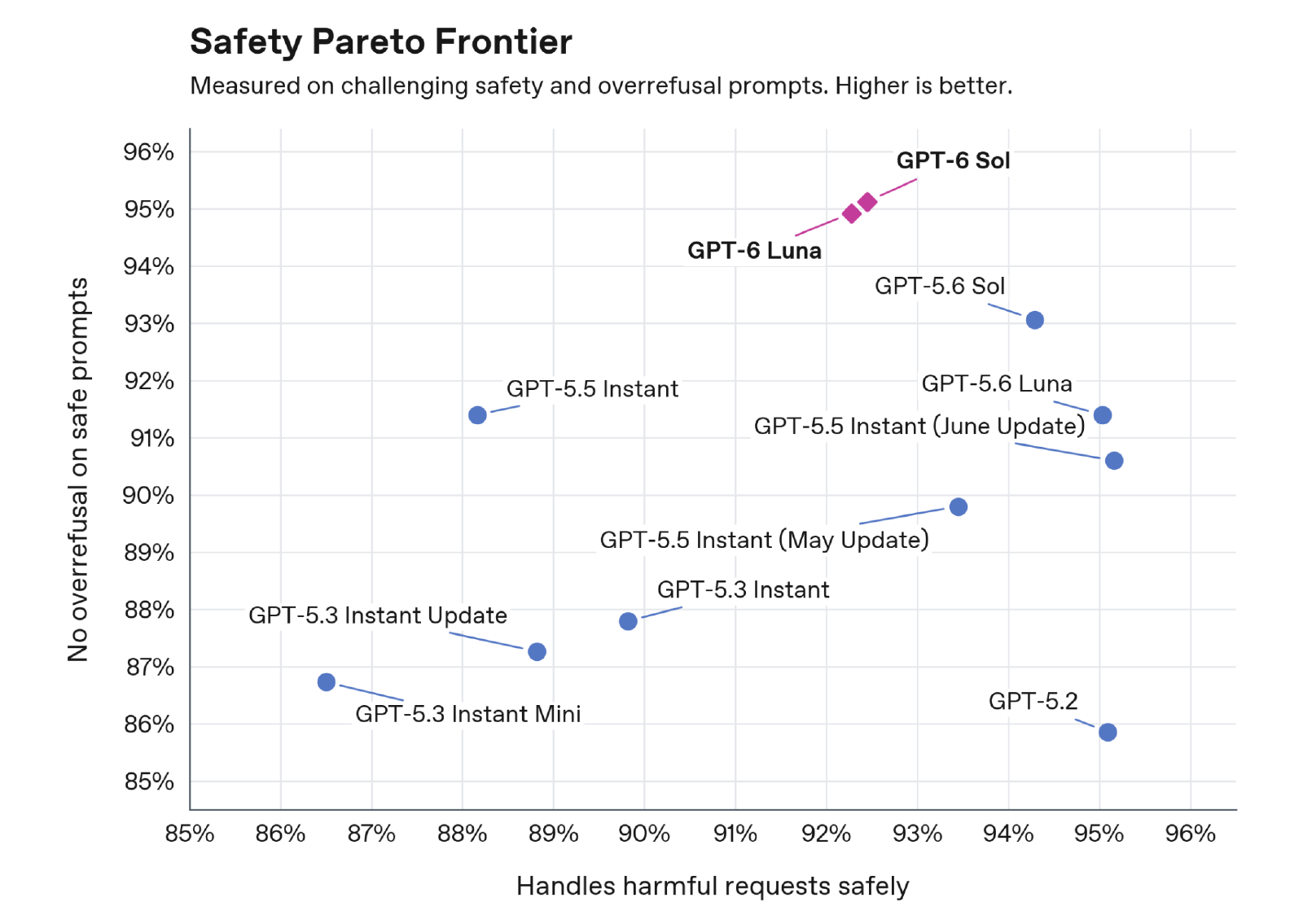
The card describes a trade-off on its general production prompts too. It says the October models refuse fewer harmless requests, "though it scores lower on some safety requests". GPT-6 Luna shows statistically significant regressions on standard self-harm, gore and sexual content, and GPT-6 Sol on standard self-harm. OpenAI says the violations it reviewed were "borderline but still generally safe".
The post says GPT-6 showed stronger resistance to multi-turn attacks. The card measures that gain against GPT-5.6 Sol. Against the September versions, the October models have "slightly lower point estimates", with overlapping 95% confidence intervals.
The card reports gains elsewhere, on OpenAI's own tests. It says factuality improved on nearly all its metrics and that both models outperform the August versions across its alignment suite. It rates both High capability in cybersecurity and in biological and chemical risk, as it did GPT-5.6.
What parents, admins and developers should check
- Parents and schools with teens on free ChatGPT can read the card's under-18 table. The card lists Parental Controls among protections its scores leave out. See OpenAI's Australian Youth Safety Blueprint maps six pillars onto Digital Duty of Care talks.
- Free and Go users can expect GPT-6 Luna in the Chat tab from 8 October US time, and can ask for fewer visuals.
- Enterprise admins decide whether their workspace gets GPT-6, since OpenAI ties Enterprise access to admin settings.
- Developers on Codex and Work need no change, because OpenAI says the models there stay the same.