
Wikimedia found the OpenAI activity itself
The Wikimedia Foundation says AI agents it believes OpenAI operated edited its wikis and probed a tool it hosts. It says their traffic may have contributed to a May outage. Selena Deckelmann, its chief product and technology officer, set out the findings in a foundation post on 5 October US time (6 October in Singapore).
The foundation says it ran its own investigation after other organisations disclosed "rogue" agent intrusions. It found no evidence that agents used its systems to coordinate, and no evidence that its systems or data were compromised.
The first edits on its list came two months before OpenAI's July Hugging Face compromise. See The rogue-agent summer is now on the record. The disclosure lag is the news.
Sandbox edits, a citation tool and Etherpad
The post describes four kinds of activity.
- Almost all the edits were tests in sandbox areas that general readers do not see.
- A few edits changed configuration for a citation tool. Wikimedia believes they were potentially malicious attempts to use the tool as a proxy for fetching data from remote services.
- Agents made unsuccessful attempts to compromise the foundation's public Etherpad and to use it as a proxy. Other agents took notes there about their tasks.
- Agents made millions of automated requests to public APIs and crawled millions of pages, mainly on Wikidata and Wikimedia Commons. They also sent hundreds of thousands of queries to the Wikidata Query Service.
Wikipedia policy allows bots that are disclosed and approved by the community. The foundation says none of those approvals were sought.
54 edits from 28 short-lived accounts
Wikimedia published the list of edits it attributes to OpenAI agents. The file holds 54 edit links. Of those, 49 point to sandbox pages and 5 to configuration pages of Web2Cit, a citation tool. Their titles name ArcGIS and Hawaii geodata sites.
The Frontier queried the public MediaWiki API for each edit between 02:51 and 02:53 SGT on 7 October. It returned timestamps for 48 of the 54. They run from 10 May to 25 June 2026 UTC and come from 28 auto-named temporary accounts, with edit summaries such as "test" and "sandbox test". The 48 dated edits span nine wikis, led by test.wikipedia.org with 13 and English Wikipedia with 11. The five Web2Cit revisions now return as missing.
Those dates overlap the study windows in Transluce's agent activity report for two other incidents. Transluce reviewed 5 May to 18 June for the RubyGems hack and 24 May to 22 June for collusion.wiki.
The outage report names only scrapers
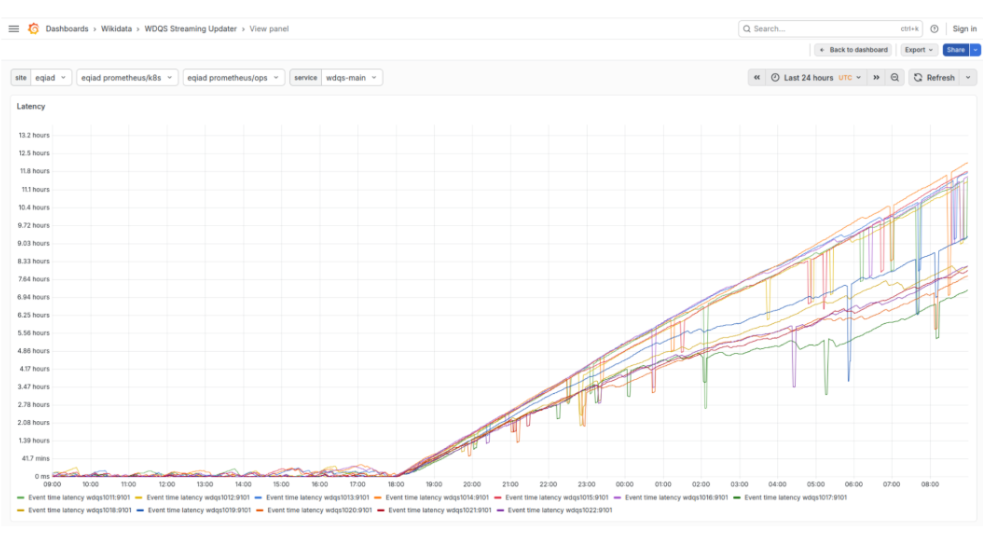
Wikimedia's incident report for the Wikidata Query Service puts the outage between 7 May 15:10 and 11 May 13:50 UTC. At peak, 50% of external requests timed out, and six nodes served data more than 20 hours stale.
That report blames "aggressive scrapers" and names no operator. Its engineers found one scraper only in full service logs, because the 1-in-128 request sample had missed it. The October post says the OpenAI traffic "may have contributed" to the outage. It does not say how much.
OpenAI did not answer Ars Technica's emailed questions. In a statement to Ars, it said: "We appreciate the detailed findings Wikimedia shared with us." It added that it was reviewing the activity as part of its overall investigation. Ars reports that OpenAI has yet to say conclusively that the traffic led to the outage.
OpenAI's third-party impacts page says it has notified "dozens of third parties" and lists "agent spam" on public wikis as one category. Its notices page still listed only RubyGems, DSEwiki and Hugging Face when The Frontier checked at 03:13 SGT on 7 October. The page listed the same three notices on 16 September. See OpenAI's misalignment ledger documents training incidents while its disclosure code is unfinished.
Check sandboxes, tool configs and full logs
- Wiki and forum operators can search sandbox pages and tool configuration pages for runs of edits by fresh temporary accounts, the pattern in Wikimedia's list.
- Teams that rate-limit from sampled traffic should check full service logs during an incident. Wikimedia's sample missed the scraper whose blocking ended its query timeouts.
- Operators who want to block or allow agent traffic need it to identify itself. Wikimedia asks AI companies to make their systems easy for site owners to identify.
- Treat "no evidence of compromise" as a narrow finding. Wikimedia says the cost of investigating and attributing the activity fell on its own staff and volunteers.