

The news
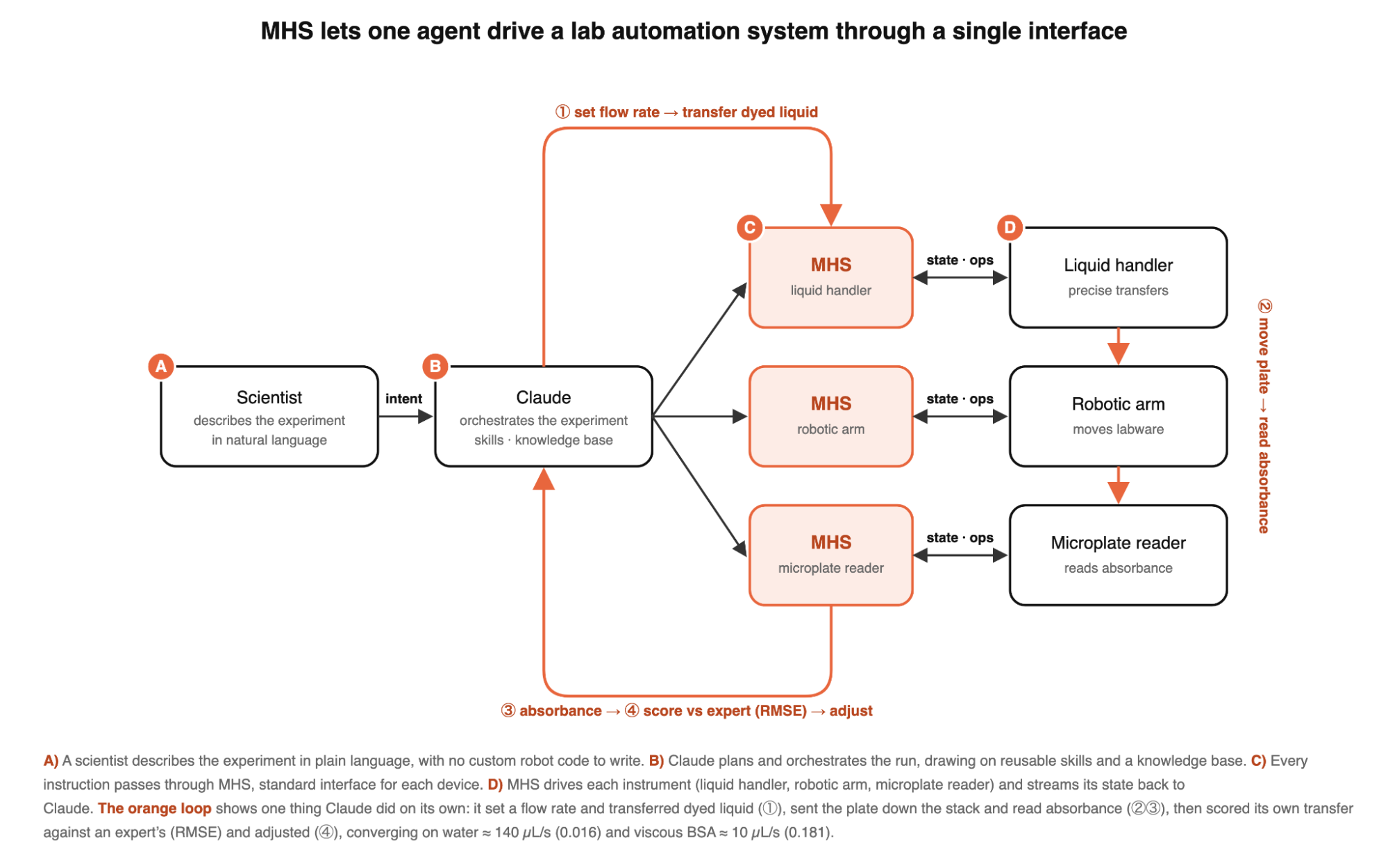 Caption: Figure published with Anthropic's MHS research-preview post · Source: Anthropic, Previewing the Model Hardware Standard, 27 Aug 2026 · link
On 27 August 2026 Anthropic published Previewing the Model Hardware Standard. MHS is a shared specification for AI agents to operate physical devices such as microscopes, liquid handlers, and robotic arms.
Development began as a collaboration between Anthropic and HHMI Janelia Research Campus. Public hub: modelhardwarestandard.com.
Who is bound
Nobody is bound by a research preview alone.
- Instrument vendors and lab-automation OEMs decide whether to ship an MHS driver.
- Research labs and advanced manufacturers in the invite cohort decide whether to expose devices to an agent harness.
- Safety / EHS officers remain responsible for physical interlocks; MHS does not replace them.
Claude is the agent shown in Anthropic's write-up. The post also says MHS is model-agnostic.
What's new
- Driver primitives. An MHS driver exposes simple operations (examples given: read temperature, set temperature) so an agent can learn a device without scraping opaque vendor GUIs.
- Three control paths. MCP, command-line interface, and code/API files, intended to orchestrate multiple devices.
- Model-agnostic framing; open source later. Anthropic says any agent harness can use MHS over standard protocols such as MCP. The post places a full open-source release after the research preview, once safety evaluations and partner feedback land.
- Early deployments named on the post:
- Genentech: proof-of-concept automating a BCA protein assay on a liquid-handler workstation; Claude adjusted flow rates from trial runs and recovered from some tip and fluid errors, with limits called out on bubble handling.
- University of Washington Baker and Pinglay labs: remote instrument monitoring dashboard and agent-supervised qPCR work described in the post.
- QuEra Computing: quantum laser stabilization case study linked from the page.
- Related open harness. Gently (Shroff Lab, Janelia) is an agentic microscopy harness referenced alongside the Janelia collaboration; README status line:
1.0.0.dev0.
What it does not settle
- No general public download of a finished ISO-style standard text is claimed beyond the research-preview apply flow.
- No published conformance test suite, certification mark, or liability allocation between model provider, driver author, and lab.
- Genentech results are a proof-of-concept. Anthropic and Genentech describe remaining limits (for example bubble-induced liquid-handling errors).
- No ship date for broad vendor adoption.
- MHS does not settle wet-lab biosafety policy for autonomous runs.
What to do now
- Lab automation leads: Apply at modelhardwarestandard.com if you already expose programmable instruments and want an agent-facing driver path.
- OEM firmware teams: Inventory whether your device API can map cleanly to read/write-style primitives and MCP tools.
- Biotech IT / safety: Keep human approval on any protocol that moves liquids or lasers; treat MHS as an interface layer.
- Ignore for Monday procurement if you only buy SaaS chat seats. There is no new Claude API SKU in this post.